
Amicus Briefs 101: A Tool For Advocacy
Our previous post discussed the importance of amicus briefs, their history, and how they have been used to shape public policy over the years. As part of the Purple Campaign’s mission, we work to establish better laws and advocate for stronger anti-harassment policies that impact the public at large. When a court considers a case that has the potential to shape future legal advocacy in the areas of sexual harassment, gender, and workplace equity, the Purple Campaign may decide to file an amicus brief to provide additional information and shed light on nuances that can help the court make its decision in a way that best advances these important interests.
Jane Roe v. United States, et al.
In 2021, the Purple Campaign partnered with Legal Momentum, National Women’s Law Center, Willkie Farr & Gallagher LLP, and other interested organizations, to draft and file an Amicus Brief in the Fourth Circuit in support of Appellant Jane Roe in Roe v. United States of America et al. The brief details the pervasive sex discrimination, including sexual harassment, and retaliation to which Roe was subjected, and outlines the Federal Judiciary’s long and public history of sex discrimination, including sexual harassment, that has been frequently acknowledged but never meaningfully addressed.
The Federal Judiciary currently enjoys an anomalous exemption from Title VII of the Civil Rights Act, which typically provides protections to employees who have been harassed at work, making it extremely difficult for judicial employees to report misconduct and receive an adequate remedy. Roe, who worked as a Federal Public Defender, was repeatedly stonewalled for requesting a safe workplace and she was denied basic due process and equal protection rights while navigating the Judiciary’s internal process. Our amicus brief argues that the federal judiciary must be held to the same standards as other employers when responding to employee reports of harassment and discrimination, and this is currently not the case. Affirmance of the lower court decision by the Fourth Circuit would only continue to perpetuate the Federal Judiciary’s deficient approach concerning workplace sexual harassment.
Tirschwell v. TCW
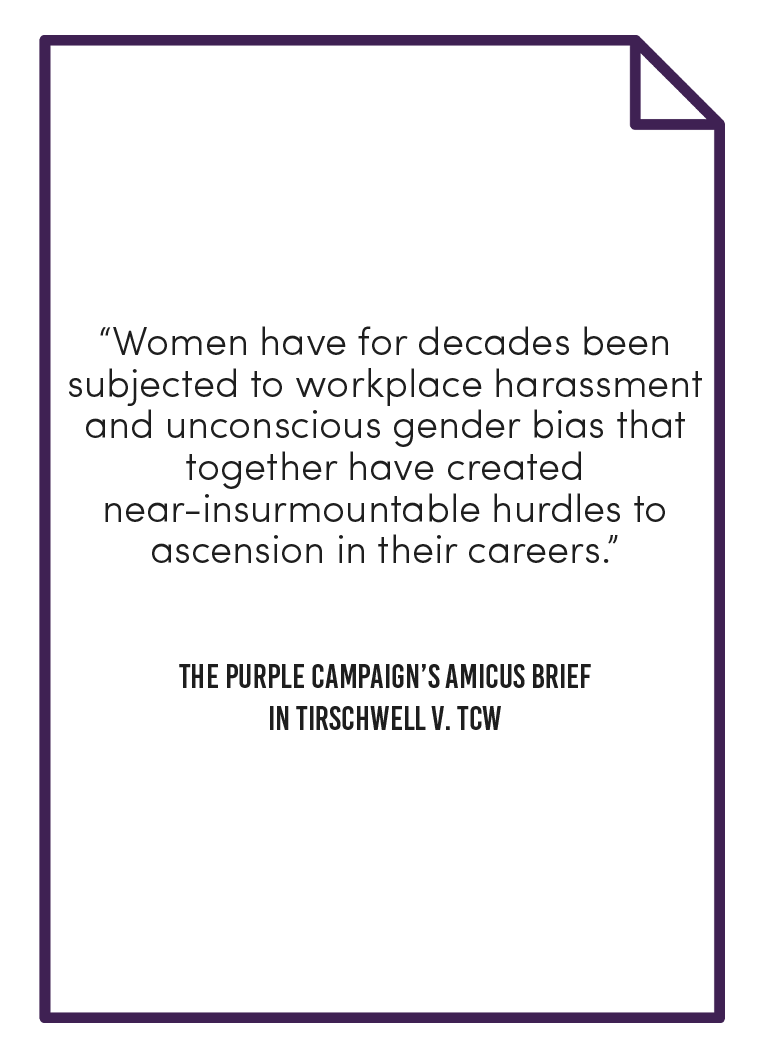
In March 2021, the Purple Campaign filed an Amicus Brief in support of Appellant Sara Tirschwell, a Portfolio Manager in the financial services industry. Ms. Tirschwell sued her employer TCW, its chief executive officer, David Lippman, and her boss Jess Ravich, in January 2018, alleging that she was fired after reporting the sexual harassment she had been subjected to. Ms. Tirschwell alleged that Mr. Ravich had made unwanted sexual advances at “breakfast meetings” that he set up to discuss business. When Ms. Tirschwell stopped the breakfast meetings, she was no longer given resources like marketing support for the projects she had been hired to oversee, and nine days after speaking with HR about the sexual harassment, she was fired.
The Purple Campaign’s amicus brief focuses on the crucial aspects of workplace sexual harassment, arguing that the judiciary needs to recognize the various ways that gender bias manifests in the workplace and the particular environments in which sexual harassment remains pervasive. Specifically, the brief discusses the unequal bargaining power and “superstar” treatment given to men like Mr. Ravich, which often leaves women in the untenable position of trying to navigate microaggressions and slights — if not more severe behaviors — in order simply to keep their jobs. Importantly, the brief addresses the intended purpose of the New York City Human Rights Law to be the “most progressive in the nation” and to provide protection and recourse for plaintiffs exactly like Ms. Tirschwell.
Notably, in May 2021, the Supreme Court of New York formally accepted our Amicus Brief and agreed that issues of fact exist about whether Ms. Tirschwell was subjected to sexual harassment, gender-based discrimination, and retaliation at work.
Dent v. Constellation
In May 2021, the Purple Campaign joined the National Women’s Law Center, Women Employed, the ACLU of Illinois, along with law firm partner DLA Piper and 27 other advocacy organizations in filing a brief in support of an employee who reported sexual harassment by an outside vendor and the third-party attorney who was hired to investigate the matter.
The state of Illinois has a rule that allows an individual to ask the court for pre-suit discovery to identify responsible individuals or entities. Pre-suit discovery is often used as a tool for fleshing out facts and witnesses prior to filing a formal complaint. However, this rule is now being used to coerce employers into identifying employees who come forward with a report of sexual harassment. In this case, Richard L. Dent et al., v. Constellation NewEnergy, Inc., et al., the intermediate appellate court held that Constellation could be compelled to disclose the name of an employee who reported harassment by Dent, as well as a witness and an investigator who had been hired to investigate the employee’s complaint.
Dent is seeking the identifying information of the employee and Constellation counsel in order to pursue a defamation claim due to allegedly defamatory statements about Dent that caused Constellation to terminate their contractual arrangements with him. Based on this holding of the intermediate appellate court, this common discovery tool could be used in the future to strip individuals of their anonymity in order to sue them for defamation which would have a massive chilling effect on sexual harassment reports. As such, Constellation petitioned for leave to appeal the decision to the Illinois Supreme Court.
The amicus brief explains for the Court why it is important to uphold standards that protect individuals who come forward with sexual harassment complaints against retaliatory defamation lawsuits. The brief provides the broader context of the problem of workplace sexual harassment, and especially the unfortunately well-founded fear of retaliation which silences many victims. Additionally, the brief explores the dangerous implications that relaxing these standards could have in terms of further discouraging reporting by victims of harassment and disincentivizing employers from taking thorough and effective corrective action.
The decision in this case has the potential to have significant and dangerous implications related to discouraging reporting and disincentivizing employers from taking robust and thorough action on these matters. As a result, the Purple Campaign signed on in support of this brief to protect these important interests.
In conclusion, the value of amicus briefs as an advocacy tool has increased significantly. Amicus briefs now play a pervasive and critical role in appellate practice. Still, organizations should be selective in deciding when to file an amicus brief, and should only do so when the case involves an issue of broad legal or public policy importance, and/or it has expertise, information, or a perspective to contribute to the case beyond what the parties can contribute. In these cases, participating as an amicus can be a highly effective way for interested organizations and individuals to help courts recognize the many nuances of important issues not only affecting the litigants, but the broader public as well. The Purple Campaign will continue to share its expertise on these issues via amicus briefs in support of cases that advance our mission to address workplace harassment by implementing stronger corporate policies and establishing better laws.